Build your own AI ad factory.
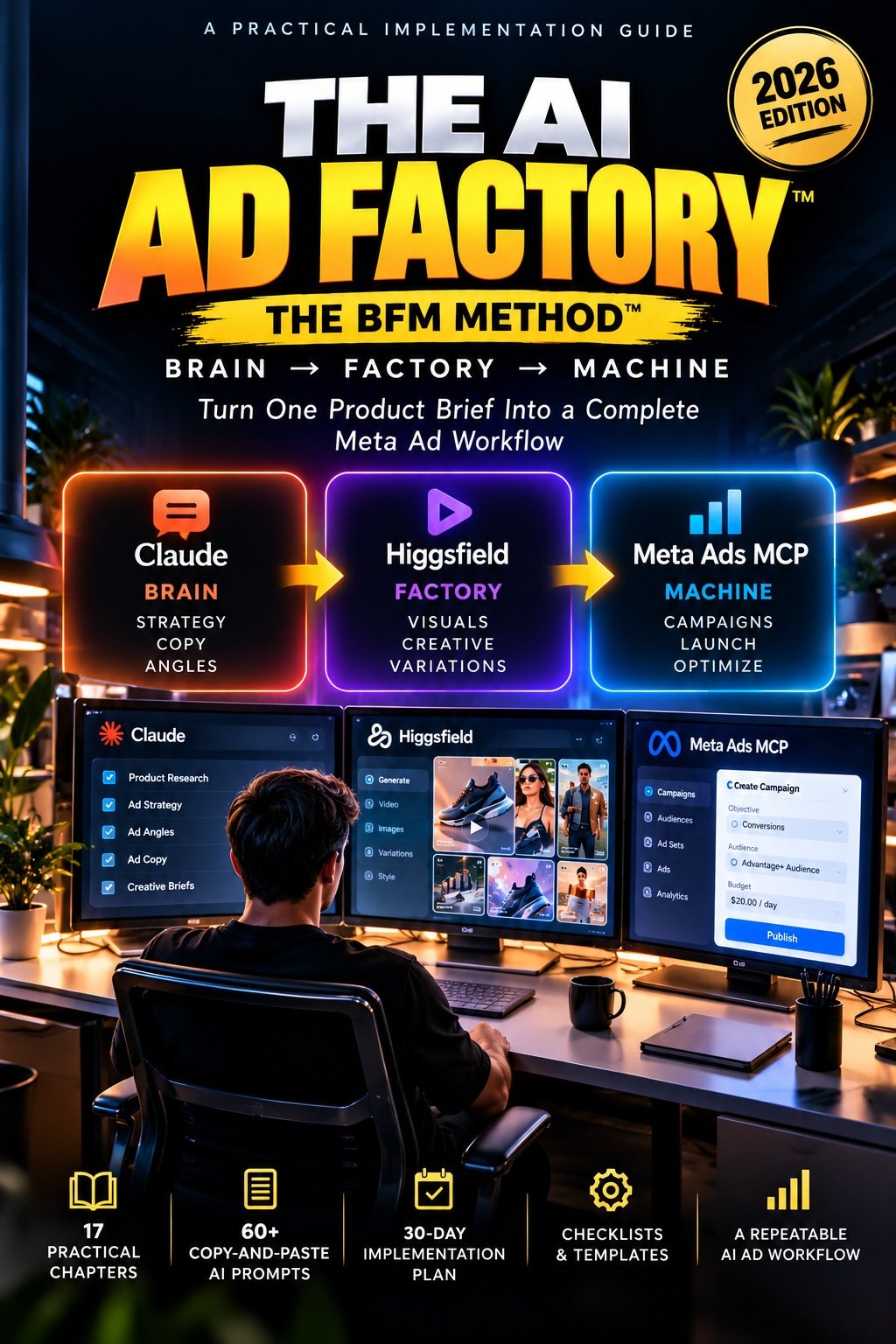
Use Claude, Higgsfield and Meta Ads MCP to plan creative, produce ads, launch campaigns and analyse performance — through a repeatable, no-code weekly workflow where you approve every rupee of spend.
Instant digital access · Practical step-by-step guide
85
pages
17
chapters
60
copy-paste prompts
30
day plan
"Everything you create is PAUSED. Never activate anything."
5 angles × 5 hooks
= 25 concepts a week
Your problem isn't one bad ad.
It's that every ad has to travel the same slow chain — and each step used to cost real money and real calendar time. Want twice the ads? Hire twice the people.
Finding a creator
Sourcing, briefing, shipping product, waiting. 2–4 weeks per round.
Shooting
Even a scrappy UGC shoot eats a day. A produced spot eats a week.
Editing
4–8 hours per variant. Multiply by ratios, hooks and languages.
Trafficking
Uploading, naming, duplicating ad sets. Mind-numbing and error-prone.
Reading results
Exporting, pivoting, summarising. Half a day a week, minimum.
| 30 video variants / month | Traditional | This stack |
|---|---|---|
| Creator sourcing | 2–4 weeks | 0 — synthetic avatars |
| Production cost | $4,500–$20,000 | $60–$150 in credits |
| Time to first cut | 10–20 days | Under an hour |
| Cost per variant | $150–$700 | $2–$4 |
| Iteration speed | Next shoot | Same afternoon |
| Trafficking | 2–4 hrs | One conversation |
| Weekly reporting | 3–5 hrs | 10 minutes |
Source: The AI Ad Factory, Chapter 1. Figures are the guide's planning estimates in USD — verify current vendor pricing.
Cheap creative tempts people to make more bad ads faster. Volume without a testing discipline is just a faster way to waste money — which is why most of this guide is about the discipline, not the generator.
Creative is
the constraint.
Meta's delivery system now finds the buyer better than a checkbox interface can. Targeting is largely solved. What's left is the thing the algorithm can't do for you: decide what the ad says and shows. And creative decays.
~5%
Typical hit rate
Only a small minority of new creatives go on to carry meaningful spend. The guide plans at 5%.
7–14d
Creative half-life
Every ad dies. The only question is whether the next one is already ready.
$3k
Spend per new ad
A planning heuristic: roughly one new ad per $3,000 of monthly spend.
At a 5% hit rate, five new ads a month produces a quarter of a winner. Forty produces two. Volume is the mechanism by which you find winners at all.
| Monthly spend | New ads / mo | Realistic winners |
|---|---|---|
| $3,000 | 1–3 | Under 1 — gambling |
| $10,000 | 4–8 | ~0.5 |
| $30,000 | 10 | 0.5–1 |
| $100,000 | 33 | 1.5–2 |
| $300,000 | 100 | ~5 |
Source: The AI Ad Factory, Chapter 1 — drawn from published 2026 creative benchmark analyses (see Appendix E).
The Three-Engine System.
Don't think of it as three apps. Think of it as three roles in a very small agency — where you're the creative director and everyone else works for free.
The Brain
Decides what to make, why, and what to do next. Reads data, writes briefs, spots patterns, drafts the plan, keeps the naming clean.
The Factory
Turns a brief into finished creative. Video, static, avatars, voice, aspect ratios. It makes the thing people see.
The Machine
The hands that let the brain reach into your real ad account — to read numbers and, with permission, create and change campaigns.
The Director
Non-delegable. This is the job that stays. The generator lowers the cost of being wrong; the loop — and your judgement — raises the odds of being right.
One weekly loop. Each cycle inherits the last one's evidence.
OBSERVE
"Pull last 14 days by ad. Show me hook rate, hold rate, CTR, CPA and spend. Group by angle."
DECIDE
"Which angles are carrying spend? Which hooks are fatiguing? Give me next week's brief: five angles, five hooks each."
PRODUCE
Feed the briefs in. Generate 20–30 variants across formats and ratios with a consistent avatar and brand look.
DEPLOY
Build the campaign and ad sets, upload the assets, name everything to the convention — and leave everything paused.
APPROVE
Eyeball the previews, sanity-check budgets and destinations, flip to active. Ten minutes.
REPEAT
Next week's observation is this week's deployment. The loop compounds because every brief is grounded in last week's data.
Compounding effect 1
Evidence-grounded briefs
When pulling the data costs one sentence, you close the loop every week instead of never.
Compounding effect 2
Readable data
Humans get lazy naming ad #47. An assistant applying a convention doesn't — so "which angle wins?" gets a real answer.
Compounding effect 3
Cheap failure
When a variant costs $2 instead of $400, you can test the weird angle. The one that lives pays for the rest.
Five parts. Seventeen chapters. Five appendices.
Part 1 is context — read it once. Part 2 is setup — do it with the book open beside you. Parts 3 to 5 are the operating system.
Part 1The MachineCh. 1–3 +
Part 2Setup Without CodeCh. 4–6 +
Part 3The Creative EngineCh. 7–10 +
Part 4Launch & OptimiseCh. 11–14 +
Part 5Scale & SellCh. 15–17 +
A–EThe Reference SectionAppendices +
Not theory. An operating manual.
Connect Claude to Meta Ads in 15 minutes
A URL, a Facebook login and three test questions — including one that checks it respects the brake.
Stand up Higgsfield as a creative factory
Credit maths, a Brand Kit interview, three named personas and a naming convention from day one.
Install five layers of budget guardrails
Standing rules, spending limits, access hygiene, a 12-point pre-flight and human creative review.
Diagnose any ad with three gates
Stop, stay, act — hook rate, hold rate, CTR — with kill / fix / good / elite benchmark bands.
Brief a week of creative from real data
Four prompts that turn last week's numbers into a 3/1/1 Angle Matrix and paste-ready briefs.
Prompt video that does what you meant
A six-block prompt architecture, seven fix-it rules and format skeletons for UGC, CGI, POV and more.
Run a 100-ads-a-month production line
A Monday-to-Friday rhythm: roughly 25 assets a week in four to six hours of your time.
Launch by conversation, manage in 10 minutes
A plan-first build prompt, then the Daily Ten — capped at three actions so you stop fiddling.
Kill, keep, scale — and beat fatigue
Decision rules written in advance, a fatigue radar prompt and a five-rung refresh ladder.
Straight from the pages.
Real excerpts, with page numbers. This is the level of specificity you get throughout all 85 pages.
1. Default to read-only…
2. Before any write, show me a plan… then stop and wait for me to type CONFIRM.
3. Everything you create is PAUSED.
…
8. Never delete anything. Pause instead.
"The single most valuable page in this book."
| METRIC | KILL | FIX | GOOD | ELITE |
| Hook rate | <15% | 15–25% | 25–35% | 35%+ |
| Hold rate | <15% | 15–20% | 20–25% | 35%+ |
| Link CTR | <1% | 1–2% | 2%+ | 3%+ |
3 proven angles · 1 adjacent variation · 1 genuinely untested. 25 concepts, each with what you learn if it wins — and if it loses.
Recommend only; change nothing.
Kill when two are true.
- CTR under 1%
- CTR down 20%+ week over week
- Prospecting frequency over 3.0
- Hook rate under 15% after 5,000 impressions
- Spend at 5× target CPA with zero results
60
copy-paste prompts, grouped by job.
Replace anything in [brackets] and send. Every prompt is built on three habits: name the account and date range, say "read-only" unless you mean to write, and ask for confidence on every recommendation.
Get the complete guide"Apply my kill rules to act_X: kill only when two or more signals are true and thresholds are met. Show the ad, the signals triggered and the numbers. Recommend only."
Don't read it. Build it.
Each day is 30–90 minutes, with a clear "done when". If you fall behind, don't skip — slide. The order matters more than the calendar.
Foundation
Read-only, no spend- Audit permissions, connect the MCP, run the 3 test prompts
- Set the spending limit, install standing rules
- Build the Brand Kit, analyse 90 days of history
- Persona #1 and one ad in every format
First production cycle
25 concepts → live- Four briefing prompts, 5×5 matrix
- 10–12 videos, 12–15 statics
- Two-pass QC — 15–18 assets survive
- Build paused, pre-flight, activate manually
Operate
Rules, not feelings- Daily Ten every morning; change nothing before day 18
- First kill decisions with the two-signal rule
- First weekly review by angle, hook and format
Close the loop
Self-sustaining- Batch two, grounded in your own data
- Mine the winner, run the fatigue radar
- Scale your top performer by ≤25%
- Personas #2 and #3, monthly review
One or two genuine winners is a normal, good outcome — at a ~5% hit rate on 30 ads, it's exactly what the maths predicts.
- ✓ 25–35 new creatives produced
- ✓ One clearly identified winning angle, with numbers
- ✓ A 90-minute briefing session, not a week
- ✓ A daily routine that takes ten minutes
Built for solo marketers. Useful for agencies.
Agencies sell creative volume and reporting — the two things this stack compresses hardest. The playbook's advice: don't price it as "cheaper ads". Sell more testing velocity per retainer.
| Deliverable | Traditional | This stack |
|---|---|---|
| 20 video ads / month | $3,000–$8,000 | $60–$150 + ~6 hrs |
| Weekly reporting | 4–6 hrs | 40 minutes |
| Monthly strategy deck | 4–8 hrs | 1–2 hrs |
| Campaign trafficking | 3–5 hrs | 45 minutes |
Creative-only retainer
Lowest risk, easiest to sell, no account access needed.
Full-service retainer
Creative, media buying and reporting — with Chapter 6 locked down.
Creative sprint
Fixed scope: 40 ads in two weeks. A door-opener to a retainer.
Done-with-you
Build the system inside their team and train them.
One client per working session. Authorise only today's account. Separate Brand Kits. Disclose AI use up front, and never present a synthetic presenter as a real customer testimonial.
Source: The AI Ad Factory, Chapter 16. Operational estimates in USD — not a promise of agency revenue or margin.
Nothing goes live without you looking at it first.
You're giving a fast, confident, literal-minded system the ability to spend money. The guide treats that seriously — five layers of protection before a single campaign activates.
Standing instruction
Eight rules pasted once: read-only by default, plan before write, everything paused.
Platform limits
An account spending limit — a hard ceiling you could survive losing this month.
Access hygiene
Least privilege, partner access for clients, never paste tokens into chat.
12-point pre-flight
Ninety seconds before paused becomes active. Catches nearly everything.
Human creative review
The assistant can't see your video. You must — sound on and off, claims checked.
Who this is for.
- ✓A Meta advertiser or performance marketer
- ✓A freelancer or agency owner running client accounts
- ✓An e-commerce operator or D2C founder
- ✓A solo founder or marketer with no engineering background
- ✓Someone who wants a practical, build-along system — not more theory
- ✕Guaranteed ROAS — outcomes vary by offer, market, creative and luck
- ✕A magic button. Volume without discipline just wastes money faster
- ✕AI to manage the account automatically — "You can. You should not."
- ✕To skip reviewing campaigns and creative yourself
- ✕A fix for a weak offer. A beautiful video for a weak offer is a beautiful failure
Questions before you buy.
Do I need coding knowledge?+
No. No engineering background is assumed and no code is written at any point. The MCP connection is a URL, a Facebook login and a test question. An optional browser-automation pattern is mentioned in a single sidebar, clearly marked as outside the no-code path.
Is it suitable for beginners or people new to Meta Ads?+
It's a build-along manual. Part 2 walks through setup step by step, the glossary defines every term the book assumes, and the 30-day plan tells you what to do each day. You'll need a Meta ad account you have admin access to.
Do I need Claude, Higgsfield and Meta Ads MCP?+
The system is built on all three. You need a Claude account, a Higgsfield plan (the guide shows you how to choose one on credit maths), and a Meta ad account to connect through Meta's official ads MCP server. Tool subscriptions and ad spend are separate from this guide.
What is Meta Ads MCP?+
MCP stands for Model Context Protocol — a standard plug shape. Meta publishes one socket for its ads system, Claude has the plug, and you connect them in a settings screen. Your assistant can then read your ad account and, with permission, create and change campaigns. Appendix B maps what it can reach.
Does the system automatically spend my ad budget?+
Not if you follow the guide. The one rule that prevents disasters: everything gets created paused. The standing rules require a plan and your typed CONFIRM before any write, and the guide recommends spending your first two weeks read-only.
Do I still need to approve campaigns?+
Yes — every time. Build paused, verify, run the pre-flight, preview every ad, then activate manually. "You click the button. Every time."
Do I need a large ad budget?+
The guide says the creative half is worth it at any spend. At small budgets, expect patience — you simply accumulate data more slowly, and no tool fixes that. The guide's figures are quoted in USD.
Is it useful if I run ads for my own business?+
Yes. Most of the book assumes you're operating your own account in "build-paused" mode. Chapter 16 adds what changes when you run it on client accounts.
How quickly can I start?+
Immediately. The guide's own advice if you only have an hour: read Chapter 1, do Chapter 3, then run the Daily Ten in Chapter 12. Week 1 of the 30-day plan is seven short sessions.
Is this an ebook or a course? What exactly do I get?+
An 85-page digital guide: 17 chapters across five parts, plus five appendices — the 60-prompt vault, the Meta Ads MCP tool reference, a metrics & benchmarks cheat sheet, a glossary and sources. No videos or live sessions.
Will the tools and interfaces change?+
Yes — every tool in this stack ships changes weekly. The workflows are designed to survive interface changes; exact click paths may not. Appendix E lists what to re-verify every quarter. Learn the loop and the tools become interchangeable.
Everything you need to build the system.
The AI Ad Factory
Powered by the BFM Method · 2026 Edition
- ✓Complete 85-page guide
- ✓17 chapters across 5 parts
- ✓60 copy-paste prompts (the Prompt Vault)
- ✓Meta Ads MCP tool reference
- ✓Metrics & benchmarks cheat sheet
- ✓30-day, day-by-day implementation plan
- ✓Agency playbook
- ✓Troubleshooting & straight answers
- ✓Glossary, sources & further reading
Instant digital access
Claude, Higgsfield subscriptions and your Meta ad spend are separate and not included.
What this guide does — and doesn't — claim.
Results described in the guide are illustrative. Advertising outcomes vary enormously by offer, market, creative and luck. No ROAS, sales or revenue is promised.
An independent educational publication. Not affiliated with, endorsed by, or sponsored by Meta Platforms, Inc., Anthropic PBC, or Higgsfield AI.
Nothing here is financial, legal or business advice. You're responsible for your ad spend, your claims, Meta's Advertising Standards and AI-disclosure rules in your market.
Stop building your ads workflow from scratch.
Get the practical guide for building a repeatable AI-powered advertising workflow with Claude, Higgsfield and Meta Ads MCP.
Get the complete guideDigital product · Instant access · {{ price }}